By JAY ROBERTS
The Cassette Chronicles is a continuing series of mini reviews and reflections on albums from the 1980’s and 1990’s. The aim of this series is to highlight both known and underappreciated albums from rock, pop and metal genres from this time period through the cassette editions of their releases. Some of the albums I have known about and loved for years, while others are new to me and were music I’ve always wanted to hear. There will be some review analysis and my own personal stories about my connection with various albums. These opinions are strictly my own and do not reflect the views of anyone else at Limelight Magazine.
JOHN WAITE – IGNITION (1982)
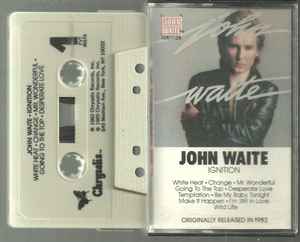
After the end of The Babys, singer John Waite unleashed his debut solo album Ignition in May of 1982. I suppose that nearly forty-four years after its release, it’s a good time for me to get around to finally listening to the album in full.
I’ve written about John Waite’s solo albums three times before in this series but now I’m back to the very beginning to get a grasp on how things started for his solo career.
That notion got a great start with the first song on the album. “White Heat” is a killer rocking track. Fiery in its pacing and packed with not just a great vocal take from Waite, but a jam-packed musical score, I was quite taken with the song. The keyboards in the song were pretty cool and in spots they got a bit more of a spotlight and for me that only enhanced the overall song.
The funny thing is that I wasn’t sure if I’d really ever heard any of the songs on the album before now. And then Track 2 quickly reminded me that yes indeed I had heard at least one of the songs. That track is the song “Change”. It was the first of two singles released from the album and while it didn’t really make a dent in the charts at the time, it remains one of John Waite’s most recognizable songs. I was also reading online that in the early days of MTV, it was one of the channel’s most popular videos.
The song “Mr. Wonderful” has a nice rhythmic style going for it. It’s fed by a strong keyboard sound in the main choruses and then the pacing kicks up into more of a rock vibe for the song’s chorus. I like the way the song bounces back between those two styles. And the guitar playing on the song is phenomenal. According to the Wikipedia page for the album, session guitarist Tim Pierce played lead guitar on the album. On this song he was really outdoing himself. But the solo on the song is credited to Spyder Downtone Butane James. This is apparently a pseudonym for Neil Giraldo. There’s more on him in the “Notes of Interest” section of the article.
For the song “Going to the Top”, the pacing has a mid-tempo groove in the lyrical passages before once again becoming more of a rock and roll track for the chorus. I was kind of surprised by just how much I found myself liking this track. And then I read that it was the second single from the album. While it didn’t have much in the way of chart success either, you can clearly hear why it was chosen to be released as a single.
The final track of the first side of the album is “Desperate Love” and much like the opening track, this one is a full one rocker. The band is cutting loose and Waite is belting out the lyrics with abandon. And I’m pretty sure that I’ve heard this song somewhere before because the song’s chorus seems very familiar to me for some reason. But I can’t think of just where I heard it. Regardless, this is a killer track!
When you flip the cassette over to Side Two, things kick off with the song “Temptation”. It’s one of three tracks on Ignition that John Waite did NOT have a hand in writing. It’s got a solid thump to it musically. I dug the subject matter of the lyrics and how John Waite delivered his vocals. The phrasing during the chorus was pretty damn cool.
With “Be My Baby Tonight”, I thought the title could have the song either going full ballad or have a real uptempo driving beat to it. Happily enough for me it was the latter. The guitar work really informs the rest of the song and you get yourself on heck of a rock and roll number with this song.
The opening of “Make It Happen” is kind of weird and that sound continues on even after the guitar track kicks in. It was kind of annoying especially when you can hear it buried in the mix at different points of the song. Still, when you ignore that part of the score, this is a foot-stomping rocker. It sounds vaguely familiar at times so I’m trying to figure out where I might’ve heard it before. This one is good enough that I think it could’ve been an interesting choice for a single release too.
The song “Still in Love with You” has a slower delivery. You might even call it the Ignition album’s ballad track. Given the song’s title and that aforementioned slower delivery, you aren’t making too big of an assumption in that direction. It’s a decent song and it does have a bit more of a livelier step than the more straightforward ballad pacing at least.
To close out the album in full, you get the song “Wild Life”. The song has a upbeat and uptempo feel to it, though not quite as much of a full on rocker like “White Heat” or “Desperate Love”. But that doesn’t detract from how good the song is on its own.
While I’ve owned the Ignition album on cassette, I’d be lying if I said I remembered playing it either at all or rarely. So perhaps if I did, that’s why some of the songs are familiar to me. But regardless of not being able to pin it down for sure, I found that I was really enjoying myself as I listened to the album in order to write this article. I think I’m going to have to give it more playing time in the future because this really was a solidly crafted album that gets overlooked for the most part when you think about John Waite’s musical catalog.
NOTES OF INTEREST: The Ignition album was produced by Neil Giraldo. Alongside wife Pat Benatar, Giraldo was on the same label, Chrysalis, as Waite.
The song “Change” got a second life in 1985 when it was featured on the soundtrack for the movie Vision Quest. The song was written by Holly Knight and originally recorded for the second album of her band Spider.
Patty Smyth and Frankie LaRocka appear on the album. Both were members of Scandal at the time.
I have now seen John Waite live twice. The most recent time was a couple summers ago. I saw him opening for Foreigner and Styx in Mansfield, MA. Despite the shorter set, he was fantastic and still sounded in great voice.
 Limelight Magazine