Tag Archives: review

THE CASSETTE CHRONICLES – DORO’S ‘FORCE MAJEURE’

By JAY ROBERTS

The Cassette Chronicles is a continuing series of mini reviews and reflections on albums from the 1980’s and 1990’s. The aim of this series is to highlight both known and underappreciated albums from rock, pop and metal genres from this time period through the cassette editions of their releases. Some of the albums I have known about and loved for years, while others are new to me and were music I’ve always wanted to hear. There will be some review analysis and my own personal stories about my connection with various albums. These opinions are strictly my own and do not reflect the views of anyone else at Limelight Magazine.

DORO – FORCE MAJEURE (1989)

After the Warlock band ceased to exist over legal disputes regarding the ownership of the name, singer Doro Pesch forged ahead with a solo career that is still going strong all these decades later. 

Force Majeure, Doro’s first solo album came out in February 1989 and after becoming a fan with the Warlock album Triumph and Agony, I was completely on board with this next offering featuring my rock and roll crush back when I was a young and dumb senior in high school.

The album actually kicks off with a cover song. This was a first for Doro and she chose an interesting song to cover with Procol Harum’s “A White Shade of Pale”. I’ve heard both versions of the song and while this is a fine cover (and certainly more of a heavier rock sounding version here), I’m not sure this was the best way for Doro to kick off her solo album. Again, it isn’t a knock on the song but if I’m making my way on my own, the last thing I’d want to do is start off by doing someone else’s song as the lead track (and first single) on the album.

The album kicks off in earnest after that cover with the song “Save My Soul”. The song is a still powerful hard rocking gem in my book to say the least. And it helps start to explain why I’ve been such a devoted fan of Doro’s all these years.

Her voice is just freaking amazing. She can rip your throat out with a razor sharp scream, fire out lyrics with rapid fire delivery and yet as the other songs side one of Force Majeure so amply demonstrate, she can delivery a stunningly beautiful and ethereally delicate vocal performance as well. 

The song “Hellraiser kicks off with a kind of Gothic-inspired feel that keys into the overall sound of the track. The song has a far more deliberate pacing except for the brief lead into the chorus where it picks up a bit before settling back down. I loved the whole vibe of the song.By the way, the song is listed as being on Side Two of the album on the Wikipedia page but it is on Side One of my cassette. I wonder if there are two versions of the album and that accounts for the way it is listed online.

For the song “Mission Of Mercy”, the slow build of the music and vocals until it explodes for the track’s chorus was really cool. I don’t mind saying that I was singing along as I listened to the song and even caught myself making the devil horns sign as I was doing so. Well, at least until I realized I was doing it and stopped. Still, this is a killer track.

For a more full-on hard rocking song, you can’t go wrong with “Angels with Dirty Faces”. It’s rocket ride of shredding music that just blows the doors off the place from start to finish.

But its the final song on on Side One that brings forth that stunning beauty I was talking about earlier. The song is called “Beyond the Trees” and it is pretty much just the piano/keyboards with Doro’s vocals. It is an absolutely beautiful song, a ballad that while shirking the lovey-dovey aspects of the style, stands out so perfectly. I remember being blown away the first time I heard it and I still think of the song in that respect every time I hear it. Doro has recorded a lot of ballads over the years but this one is always going to be one of my most favorite ones.

You get a trio of hard driving rockers to open things up the second side of the album. While I was listening to the songs for this article, I was struck by the notion that this was almost like a trilogy of violence. First you get punched in the face with “Hard Times” (which was the 2nd and final single from Force Majeure), then you get kicked in the teeth by “World Gone Wild”. That song seemed to be a relentless sonic attack in terms of the fire and fury it had fueling the music and the way Doro delivered the vocals. By the way, “World Gone Wild” was the song that seems to have swapped places with “Hellraiser” in the track listing for the album.

Finally, you get kicked in the groin with “I Am What I Am”, which is even more of a blazing rocker as Doro serves up a machine gun vocal track for a song that is just barely over two-and-a-half minutes in length. The lyrics definitely stand out as a declarative statement from Doro as well.

The way those three songs hit you over and over again, when you get to the song “Cry Wolf”, you need the musical respite it provides as the music downshifts just a bit. The song moves a lot slower in the main lyrical passages though it does get much more of a fuller sound for the roar of the chorus.

That respite is short-lived though because the song “Under the Gun” is pretty much a companion piece to “I Am What I Am” in terms of an unleashed force of furious heavy metal. Bobby Rondinelli’s drums are particularly powerful in powering the music of this song and again, Doro just rips your throat out with her vocal delivery.

“River of Tears” doesn’t have the same kind of Gothic thrust like “Hellraiser” but it does have the same kind of storytelling feel to it. Much like “Cry Wolf”, the song starts off in more of a midtempo delivery before things get heavier for the chorus and towards the end of the track as a whole.

The album closes out with a brief (just 36 seconds) a capella vocal from Doro. She’s singing in German (which is a tradition for her albums). It’s called “Bis Aufs Blut” which translates apparently to “Till It Bleeds”. I love this song short but because of how special it sounds, I’ve never bothered to see how the rest of the lyrics translate. I’m happy to leave it undiscovered so it doesn’t change the “magic” of the song for me.

Over the many years I’ve been a fan of Doro Pesch, I’ve seen her twice in concert and got to meet her after the second show. Hell, the profile photo on my Facebook page is a photo of the two of us. Even when she didn’t have US distribution for her albums, I would buy them through import companies. She’s long been my choice for “Metal Queen” and the Force Majeure album does a great job of letting listeners discover the wide tapestry of Doro’s talents to say the least. This is an album I love to pop in every so often. It reminds me of just how much I love her music and why.

NOTES OF INTEREST: Despite being packed with 13 tracks and being just a really damn fine album, Force Majeure had just about zero commercial success in the US when it was released. It peaked at #154 on the album chart. It apparently sold a lot better in Europe though.

While bassist Tommy Henriksen had 5 co-writing credits on the album, guitarist Jon Levin’s sole songwriting credit is for co-writing the song “Under the Gun”. In a way, that’s too bad because his playing on the album is intense. Also, Levin’s last name is incorrectly spelled as “Devin” on the album’s liner notes. The majority of the songwriting for Force Majeure was otherwise done by Doro Pesch and Joey Balin. Balin also produced and arranged the album.

Drummer Bobby Rondinelli, who rounded out the recording lineup for the album, has played with Rainbow, Scorpions and others across his lengthy career. The keyboards were played by former Dio keyboardist Claude Schnell who is credited as an “additional musician”.

THE CASSETTE CHRONICLES – BRUCE DICKINSON’S ‘BALLS TO PICASSO’

By JAY ROBERTS

The Cassette Chronicles is a continuing series of mini reviews and reflections on albums from the 1980’s and 1990’s. The aim of this series is to highlight both known and underappreciated albums from rock, pop and metal genres from this time period through the cassette editions of their releases. Some of the albums I have known about and loved for years, while others are new to me and were music I’ve always wanted to hear. There will be some review analysis and my own personal stories about my connection with various albums. These opinions are strictly my own and do not reflect the views of anyone else at Limelight Magazine.

(WRITER’S NOTE: THIS WILL BE THE LAST ARTICLE IN THE CASSETTE CHRONICLES SERIES FOR 2023. THERE WILL BE A BEST OF THE YEAR PIECE NEXT WEEK AND THEN THE SERIES WILL RETURN FOR ANOTHER YEAR AT THE START OF 2024.)

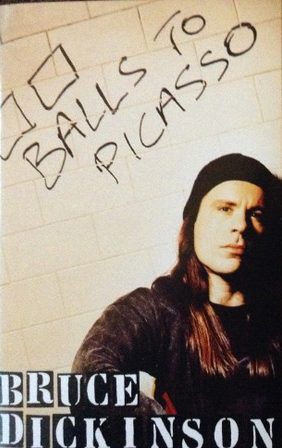
BRUCE DICKINSON – BALLS TO PICASSO (1994)

Released in 1994, Balls to Picasso is Bruce Dickinson’s second solo album. However, it was the first one he made following his departure from Iron Maiden. It was the start of his collaboration with guitarist/producer Roy Z and the album was recorded with Z’s band Tribe of Gypsies.

I wrote about Dickinson’s Tattooed Millionaire back in 2022 and while I liked the first side of the album, I found the second side more problematic. So, when it came time to listen and write about this album, I found myself really hoping I liked the album in full. One thing I noticed about the album’s tracks is how more than a few of them mixes a more sedate opening with the more in-your-face more commonly associated with Dickinson’s vocals. Hard Rock combined with metal overtones. This isn’t a surprise so much as it makes for a pretty interesting listening experience as you can clearly see how Dickinson was still making the concerted effort to mix things up so the solo music didn’t sound like “just” another Iron Maiden record.

With Dickinson and Roy Z. co-writing most of the material together (Dickinson’s son Austin has a credit on “Laughing in the Hiding Bush” and bassist Eddie Casillas has a credit on “Fire”.), the album gets off to a lengthy start with the song “Cyclops”.

The track begins with nothing in the way of build-up, it just kicks off out of your speakers for a mostly low key beginning before a brief harder edged flourish that gives way to more of a sedate delivery for the main lyrical passage. But as the song approaches the chorus, the music grows into a intense blast of rock. And Dickinson’s vocal gets more intense as he intones “We watch you breathe through the camera’s eye.” The song is nearly 8 minutes long and after the guitar solo, the music stays in that higher gear. It’s just a beast of an opening track and captures my attention every time I listen to the album. The song’s outro goes on for a good amount of time but it doesn’t lessen the song’s impact at all.

On “Hell No”, I love the way the song starts with this kicking drum beat before Bruce Dickinson’s vocals come in. The first couple of lines, he’s delivering the vocals in a rather understated manner but he quickly puts forth a bolder vocal stance towards the end of the first lyrical stanza. This type of back and forth plays out for most of the song’s vocals. The same kind of vocal delivery is employed on “Gods of War” as well.

The first side of the album is only four songs long but when the first side closes out on one of the songs you would highlight as a particular favorite, things are going well I’d say. On “1000 Points of Light”, I love the way Dickinson’s vocals during the main part of the lyrics are pretty crystal clear, delivered more in a rapid fire manner. The chorus sounds more like how you’d expect to hear him singing, but it melds perfectly together and gives you one hell of a great track.

It has been a while since I listened to Balls to Picasso before sitting down to write this article so I found myself hearing things a bit differently than I have in the past I’m sure. But before heading into the second half of the album, I know that I was really getting drawn in to the music once again.

The album’s second half (six songs) opens with the song “Laughing in the Hiding Bush”. The song’s opening is more dramatically presented but when you get to the chorus, there’s a bit more of a vicious edge to how Dickinson’s vocals come out, particularly as he sings the song’s title. I like this version of the song no doubt, but I found myself curious as to how it would’ve come out if the harder edge provided in the chorus vocals had been employed for the entire vocal turn.

I remember thinking the song “Change of Heart” was the “ballad” track for Balls to Picasso. It’s got the softer vocal focus throughout and then gets the more uptempo pace for its chorus like pretty much any “power ballad” you could think of, but this track really struck a chord with me. Whether the tempo was slow or fast, I loved the sentiment from the lyrics a lot and that made me that much more interested in the track. The brief guitar solo for the song focused more on a feel than an over-the-top flurry of notes. Pretty much all of the guitar work on this track was pretty cool to be honest.

There’s more of a concerted hard rocking style on “Shoot All The Clowns”. There’s not much in the way of a soft intro leading into a more intense flourish. Bruce Dickinson and the band pretty much rock out the whole way through. And they do it with style here. That mid-song vocal break where Dickinson is just spitting out the lyrics is flat out cool. This is just a killer track.

The song “Fire” starts out with a solidly uptempo feel and has a great line in the chorus with “Money won’t pay for the trouble you cause, trouble’s coming back for more”. The chorus alone would make me like the song but I like the way the music comes out on this one too. Sometimes fiery, sometimes understated yet always smoking with some killer guitar lines as well.

There are plenty of great tracks on Balls to Picasso but the one that stood out as my personal favorite has to be “Sacred Cowboys”. The song is in full attack mode pretty much from the start. A static burst musically combined with another rapid fire almost spoken word delivery from Bruce Dickinson but then as the musical intensity increases you get this freaking awesome chorus including this great couplet “Where is our John Wayne, where’s are sacred cowboys now”. Add in a blazing score and an abrupt yet perfectly cast ending and you have a song that just rocks me every time I listen to it.

The album closes out on the song “Tears of the Dragon”. It’s the song that got the most attention for the album and was probably the main reason I picked up the album in the first place. It has a cool melodic sensibility running throughout the song. Both sides of Dickinson’s vocals are on display here and they work in perfect harmony. The more measured tone of the main lyrics have his straightforward delivery. But that chorus gives listeners that soaring vocal tone we all know and love. It elevates the song as a whole and I vaguely remember getting goosebumps the first few times I heard the song.

I haven’t mentioned much about Tribe of Gypsies in the piece but I have to say that as a whole, I can’t imagine how anyone else could’ve done a better job being the right backing band for Dickinson on this album.

As the album finished, I couldn’t help thinking back to when I first heard it for myself and though it is pretty different stylistically from the Iron Maiden material, I loved the different tact Bruce Dickinson took for this album in order to differentiate himself apart from Maiden.

Bruce Dickinson has a new solo album called The Mandrake Project coming out soon but before the focus turns to his present musical project, it is always nice to take a look back and get a renewed appreciation for what has come before. I know that giving high praise to anything from Bruce Dickinson is pretty much adding my voice to a rather large choir, but if you haven’t checked out Balls to Picasso yet, let me just give you my own recommendation to do so as soon as possible, you won’t regret it!

NOTES OF INTEREST: The Balls to Picasso album that was released in 1994 was actually the third attempt at the album. The first two versions were junked when Bruce Dickinson wasn’t happy how they turned out.
The 2005 Extended Edition CD release of Balls to Picasso includes a 16-track bonus disc.

The original plan had been to title the album after the song “Laughing in the Hiding Bush”. Artwork was commissioned from legendary cover artist Storm Thorgerson but according to the album’s Wikipedia page, they couldn’t afford it. That artwork would go on to become the cover for the Anthrax album Stomp 442.