Category Archives: Cassette Chronicles

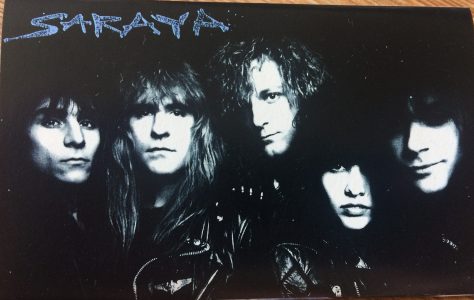
The Cassette Chronicles – Saraya’s self-titled debut

By JAY ROBERTS

The Cassette Chronicles is a continuing series of mini reviews and reflections on albums from the 1980’s and 1990’s. The aim of this series is to highlight both known and underappreciated albums from rock, pop and metal genres from this time period through the cassette editions of their releases. Some of the albums I have known about and loved for years, while others are new to me and were music I’ve always wanted to hear. There will be some review analysis and my own personal stories about my connection with various albums. These opinions are strictly my own and do not reflect the views of anyone else at Limelight Magazine.

SARAYA – SARAYA (1989)

 When I first started looking up information for the self-titled debut album from Saraya, I was surprised to see that some of the push on the band’s behalf included promoting them as a female-fronted version of Bon Jovi.

I don’t know if that is entirely true or not, but if so I don’t think it served to help the band in the least. They just didn’t seem to be even close to the level that Bon Jovi was on at that time. I’m talking song quality, etc.

Now, don’t take that for saying that I think the music is bad. Quite the contrary actually. But I know that I only barely remember the band myself so it isn’t like these songs have that “timeless” quality to them that makes you hum them decades later like “You Give Love a Bad Name” or “Living on a Prayer”.

Though I didn’t buy this album when it came out, I remember the song (and accompanying video) for the lead track “Love Has Taken Its Toll”. However, I thought that would be it for me in terms of recognizing any of the material on this album. So you can imagine how happy I was to realize that the songs “Gypsy Child” and “Back To The Bullet” were also songs I remembered. I can’t offer an explanation as to why I know the songs but as they played while I was listening to the album in order to write this article, I could sing the lyrics in my head right along with singer Sandy Saraya.

With “Love Has Taken Its Toll” kicking the album off, I’d hoped for a nice run of rocking songs but the very next song on Side One of the album was “Healing Touch” and I just could not get into it at all. I thought it kind of squandered whatever momentum the first song had built up in my mind.

All was not lost though. The last three songs on Side One are all pretty darn good. There’s the aforementioned “Gypsy Child” but the closing track, “One Night Away” rocks pretty hard too. As for “Get U Ready”, I thought the band was their most aggressive sounding on the number. The vocal take was more aggressively performed and I thought that Sandi Saraya going that way made the song that much better.

The majority of the songwriting featured Saraya, guitarist Tony “Bruno” Rey and keyboardist Greg Munier but Sandy Linzer received a co-write credit on 8 of the 11 songs on the album. He also executive produced the band. When I looked up information about him, he’s been a pretty active songwriter since the the 1960’s, even if it wasn’t in the more rock or metal driven arenas.

But whatever the collaboration between them all, the second side of the album continued to bring about some really strong songs for me to listen to. There was a soft opening with Munier’s “Alsace Lorraine” instrumental but that song fed directly into “Runnin’ Out of Time” which was another fast paced rocker that really catches your ear. After the “Back To The Bullet” song you had the song “Fire To Burn” and that was a damn fine listen as well.

You’ll note that I’ve yet to discuss any songs that would be classified as a ballad. This would be down to the fact that the band really hadn’t put one on the album’s running order to this point. That changed with the song “St. Christopher’s Medal” and I kind of wished it hadn’t. There’s nothing to see or hear with this track and I was rather glad when the song faded to black. The last track “Drop The Bomb” finished off the album in a more rocking style and for that I’m pretty glad.

I actually listened to this album at work and my co-worker that hates everything I play was somewhat complimentary towards this album. He said he’s heard far worse (I did say SOMEWHAT) and thought Sandi Saraya reminded him of Pat Benatar with Tony Rey’s guitar had him thinking Rick Derringer.

For me, my prior knowledge of the band’s music was very limited. I’ve found that my ignoring of the album 30 years ago was a mistake because they actually had some real quality music for rock and metal fans. Whether they are all that well remembered now is besides the point for me. Saraya put out a really good album and I wish I hadn’t been so clueless back then.

NOTES OF INTEREST: The band would go on to release one more album, 1991’s When The Blackbird Sings, before breaking up. They also had the song “Timeless Love” on the soundtrack to the Wes Craven movie Shocker. That track does not appear on either of their albums. There was an attempt to put on a reunion show at a British rock festival in 2010 but it didn’t end up happening.

Most of the band seems to be out of the music business these days, but Tony “Bruno” Rey has gone on to work with acts like Joan Jett, Enrique Iglesias and Rihanna. He was also a part of Danger Danger in 1988 – 1989 and appeared on a number of tracks on their first album.

Keyboardist Greg Munier appeared on the band’s second album but left the band over the direction the music was taken. Sadly, he passed away in 2006.

t


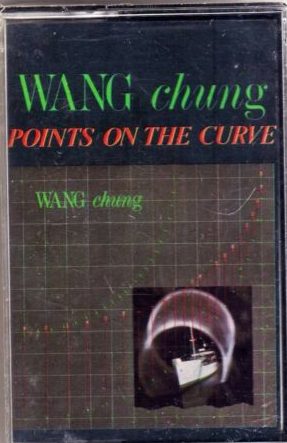
The Cassette Chronicles – Wang Chung’s ‘Points on the Curve’

By JAY ROBERTS

The Cassette Chronicles is a continuing series of mini reviews and reflections on albums from the 1980’s and 1990’s. The aim of this series is to highlight both known and underappreciated albums from rock, pop and metal genres from this time period through the cassette editions of their releases. Some of the albums I have known about and loved for years, while others are new to me and were music I’ve always wanted to hear. There will be some review analysis and my own personal stories about my connection with various albums. These opinions are strictly my own and do not reflect the views of anyone else at Limelight Magazine.

WANG CHUNG – POINTS ON THE CURVE (1984)

As it is stated in the heading of this series, the music I write about for The Cassette Chronicles covers the rock, pop and metal genres. Of course, it is plainly easy to figure out that the majority of the articles really focus on rock and metal. But I do like to throw in a pure pop music album every so often, just to keep me and everyone else on their toes. And that’s part of the reason for how this week’s article came to be about Wang Chung.

Back in the days when American Top 40 was my musical bible, the Sunday morning countdown was the be all, end all of the week for me. And Wang Chung played a part in that with the songs “Dance Hall Days” and “Everybody Have Fun Tonight”. I remember those songs well and still hear them somewhat regularly on the radio station that I listen to at work.

That radio station and a co-worker are a secondary reason for why I picked up this album on cassette when I had the chance. That co-worker is a huge blues and jazz fan and every time I play something at work that is rock or metal, he hates it. His reaction to the band Nightwish was like he had a peanut allergy or something.

Oddly enough though, when he was first hired and our musical preferences had been established, we were listening to the station and “Dance Hall Days” and he simply stated that he really liked the song. This kind of blew my mind since it wasn’t jazz or blues. Even though I like the song, I just wasn’t expecting his positive reaction. And then he heard “Everybody Have Fun Tonight” (from the album Mosaic, which may be a future article in this series) and raved about that one too. This made me even more assured of buying the albums when I had the chance so that he could hear them at work and I wouldn’t have to listen to his whining about the music I picked. So yaaay to Wang Chung on that front.

The funny thing is that while researching this album, I discovered that they actually had five Top 40 hits in their heyday. But since I never bought any of the albums back in the day, the two previously mentioned songs are quite honestly the only ones I actually remember. So this meant I would have no preconceptions about Points on the Curve since I only knew about “Dance Hall Days”.

What I learned is that while others might really enjoy the group’s music, besides the hit singles I know, Wang Chung had some songs I was surprised to find myself enjoying and then a whole bunch of other material that just left me cold. The album opens with “Dance Hall Days” and I learned that this was a second version of the song. The track had been originally released as a single in 1982 and the band re-recorded it for this album. And I still really dig the song. It was the most successful of the four singles released from this album. The song “Wait” featured a jaunty little uptempo and quite intriguing musical soundtrack. I will say that I thought “Don’t Let Go” was pretty darn good song as well. However, “Don’t Be My Enemy” was a song that I found wanting for something more.

As for the album tracks on Side One, “True Love” came off a bit too strident in the vocal area for me. As for “The Waves” and “Look At Me Now”, I just wanted to get through them and move on to Side Two.

As I said, I liked “Don’t Let Go” and didn’t care for “Don’t Be My Enemy”, but sadly the other three tracks on this side all fell into the “Dislike” category for me. While “Even If You Dream” and “Talk It Out” were songs that just didn’t appeal to me, “Devoted Friends” just seemed to drag endlessly on ad infinitum.

Now I realize that pop music, even during the era when I was actually listening to it, may not be my area of even the slightest level of expertise for me. That said, for me Points On The Curve kind of amply demonstrates why I’m (with notable exceptions) more of a singles kind of listener these days when it comes to 80’s pop.

NOTES OF INTEREST: This was the band’s second album, but the first released as “Wang Chung”. Their original name was “Huang Chung”, which served as the title of their first album as well. Despite the pronunciation being the same, they reportedly changed the spelling of the name because fans were pronouncing it “Hung Chung”.

While their have been other band members in the group over the years, the mainstays of Wang Chung have been singer/guitarist Jack Hues and guitarist Nick Feldman. The group split up in 1990 but got back together in 1997. During the separation, Feldman formed the group Promised Land with Culture Club’s Jon Moss. They released a self-titled album in 1992. Jack Hues did a one off project with Tony Banks from Genesis called Strictly Inc. and they released a self-titled album in 1995.

Wang Chung is still active to this day and are featured on this summer’s Lost ’80s Live 2019 tour. [The co-publisher of Limelight Magazine attended their concert at The Theatre at Grand Prairie in Texas last weekend and said they were one of the best live acts on the bill.]

The song “Don’t Let Go” was used in the video game Grand Theft Auto: Vice City Stories.

The Cassette Chronicles – Styx’s ‘Edge of the Century’

By JAY ROBERTS

The Cassette Chronicles is a continuing series of mini reviews and reflections on albums from the 1980’s and 1990’s. The aim of this series is to highlight both known and underappreciated albums from rock, pop and metal genres from this time period through the cassette editions of their releases. Some of the albums I have known about and loved for years, while others are new to me and were music I’ve always wanted to hear. There will be some review analysis and my own personal stories about my connection with various albums. These opinions are strictly my own and do not reflect the views of anyone else at Limelight Magazine.

STYX – EDGE OF THE CENTURY (1990)

While I would go on to discover the earlier music (and hits) from Styx over the ensuing years, I’m one of those people who first became aware of the band because of the song “Mr. Roboto”. This is not something I’d bring up first upon meeting the current lineup of the band, but I was 12 or so when I first hear that song and much like the rest of the listening audience that made the song a major hit, I was all about that song. Not the album it came from mind you, just the song.

But as I said, the passage of years made me a much bigger fan of their most successful period of chart hit music. Until now, I’ve never really dug into the band’s music from 1990 onward. Call it willful ignorance or just the fact of only having so much time, but there it is.

After the success of the Kilroy Was Here album in 1983, guitarist Tommy Shaw departed the band in 1984 and for about a five year period various members of Styx set about releasing solo music to varying degrees of success. But they got back together as a unit and ended up with Edge of the Century coming out in 1990. The lineup was missing Tommy Shaw who was at the time part of Damn Yankees, the band he formed with Jack Blades from Night Ranger and Ted Nugent. In his stead, guitarist/vocalist Glen Burtnik was brought in as his replacement.

The band’s 12th album featured three singles with the ballad “Show Me The Way” being the most successful as it hit #3 on the charts. The album itself would be certified gold. But given the nature of the struggle the band faced between balancing the more hard rock style versus the pop ballads, I was curious to see what I thought of the album nearly thirty years down the road.

Well, I can say that the album’s first side was somewhat of a shock to the system for me. Despite it’s hit single status, I found “Show Me The Way” more than a bit offputting. I suppose given the pop radio aspirations Dennis DeYoung (who produced the album) had for the band’s music the song was fine but if I’d heard it upon its release in 1990, I would’ve been turned off to it. Much like the other Side One songs “Love At First Sight” (which hit #25 on the singles chart) and “All In Day’s Work”, the song came off as souless and calculated to me. I’m not opposed to hitting the singles chart with songs but the sappier the material, the less interest I have in it. And “sappy” was the name of the game on these three songs.

That said, the album’s third single was “Love Is The Ritual” and it served as the opening track for Edge of The Century. It started off a bit too “poppy” for me but once the music kicked in with some more rocking sounds, the track became far more interesting and I ended up quite enjoying the song.

As for the title track, that song is just flat out fantastic! A full-on rocker from start to finish with some really great guitar work enhancing everything about the song.

My disappointment with the first side left me a little wary of what Side Two would contain. I didn’t hold much hope for a whole lot of material to write good things about. But as the saying goes, “that’s why you play the games”. Or in music terms, why you actually listen to the entire album. The second side of the album is just GREAT!

The side opens with two pure rockers in “Not Dead Yet” and “World Tonite”. Besides the more obvious uptempo pacing to the music, the vocal takes/delivery on both songs is top notch. I’d venture to say that I’d hold these two songs up as the best tracks for me on the release. Throw in another rocking track in “Homewrecker” and you’ve got a killer triumvirate of fiery sounding rock and roll.

But things don’t stop there. The second side of the album has two ballad type songs on it. I know you are thinking that I’m going to dump all over them but surprisingly that is not the case. Instead I really enjoyed the songs “Carrie Ann” and “Back To Chicago”. While the softer nature of both songs are obvious, what made them winners in my opinion was the band did a far stronger job of balancing both sides of their sound. There’s the right mix of the ballad and some rock and roll on each song to make it a complete whole. That’s what I always hope for whenever any artist decides to do a ballad, that they don’t forget their rocking side in the quest for a song that people will now hold up their lit cellphones to.

The odd thing about writing about this album is that I’m pretty sure this is the first Styx album I’ve ever actually owned. Thinking off all their best loved releases and I have none of them made me realize I need to rectify this situation. I’m definitely not sold on the stridently commercial ballads on the album’s first side but given how much I loved everything on Side Two, Edge of the Century definitely piqued my interest for the band’s latter-days material!

NOTES OF INTEREST: This was the only album recorded by the lineup of Dennis DeYoung, James “J.Y.” Young, Glen Burtnik, John Panozzo and Chuck Panozzo.

While guitarist Young is still with Styx full-time to this day, bassist Chuck Panozzo has toured with the band on a part time basis due to various health issues (Ricky Phillips has been the full-time bassist for Styx since 2003). Dennis DeYoung has been out of the band since 1999 and recently has been on a 40th Anniversary tour for the Styx album The Grand Illusion.

Sadly, drummer John Panozzo died in 1996. The band paid tribute to him on their 1999 live album Return To Paradise with one of the three studio tracks included on the release. It was called “Dear John” and it was written by the returned Tommy Shaw.

Glen Burtnik was out of the band in 1991 and when the band reunited in 1995, Tommy Shaw had come back. But he was brought back to be the band’s bassist from 1999-2003 and recorded the album Cyclorama with them. He also appeared on three live releases during his second run with the band.

As for the current incarnation of Styx, they are still active and out on tour. In 2017 they released a critically acclaimed album called The Mission.

The Cassette Chonicles – Keel’s ‘The Final Frontier’

By JAY ROBERTS

The Cassette Chronicles is a continuing series of mini reviews and reflections on albums from the 1980’s and 1990’s. The aim of this series is to highlight both known and underappreciated albums from rock, pop and metal genres from this time period through the cassette editions of their releases. Some of the albums I have known about and loved for years, while others are new to me and were music I’ve always wanted to hear. There will be some review analysis and my own personal stories about my connection with various albums. These opinions are strictly my own and do not reflect the views of anyone else at Limelight Magazine.

KEEL – THE FINAL FRONTIER (1986)

It was just about a month ago when I wrote about the 1987 self-titled Keel album. I found myself surprisingly taken with the album. After the article was posted and I had promoted it around the Internet, the majority of the feedback that I saw tended to mention that the reader recommended the band’s album The Final Frontier as well.

As luck would have it, I had the album in The Big Box of Cassettes so I decided to check it out and let those who had recommended it know what I thought. I need to mention that much like the Keel album, my copy of The Final Frontier played well enough for me to listen and write this article but I do plan to upgrade to a CD version as soon as I can.

The album was Keel’s third release and the second in a row to feature Gene Simmons as the producer (after 1985’s The Right To Rock). The album’s title track led off the release and in all honesty, I was kind of underwhelmed by it. There was just something that seemed to be missing that would’ve led to capturing my imagination. I could probably safely say the same about the song “Hear Today, Gone Tomorrow” as well.

But the other three songs are actually quite musically endearing! “Rock and Roll Animal” kicked up the energy level with the song infused by some quite notable guitar work, particularly the solo. The lyrics reminded me of that time in the mid-to-late 1980’s when I was still able to delude myself into thinking I was ever going to be some kind of rock god. Spoiler alert: That didn’t happen! But it sure is nice to get that kind of buzz from a song these days.

The band’s cover of the Patti Smith Group’s song “Because The Night” (co-written by Smith and Bruce Springsteen) was actually quite good. The radio station I have to listen to at work plays the original version and I’m always kind of energized when they do. Keel does up the more rocking nature of the music but I still found it to be a great version, one that makes the song their own while still maintaining a kind of faithful nod to that original version of the song.

I think Keel had an unintentional notion towards saving the best for last because my two favorite songs on the album are sequenced as the last song on each side of the album. Side One’s closing number is “Arm and a Leg”, a rip-roaring rocker that goes for the throat from the first note and shines an extended spotlight on the guitar playing from Bryan Jay and Marc Ferrari.

The second side of The Final Frontier breaks out at the start with a huge anthemic rocker in “Raised On Rock”. I thought the vocals on this song really set it up to be one of the better tracks on the release. With the song “Just Another Girl”, I thought there was the potential for the song to go off the rails but with a surprisingly strong chorus, the song really came together nicely. I wish I could say the same for the album’s ballad / power ballad type song “Tears of Fire”. I just didn’t care for it.

The light touch instrumental “Nightfall” gives listeners a brief respite before leading directly into the album’s closing track “No Pain No Gain”. As I said with “Arm and a Leg”, the band saved the best for last because the song is all fiery attitude and a blazing killer sound. I can’t quite make up my mind as to which of the two “last” songs I like best but both are just fantastic.

I don’t always take feedback suggestions from those who read the articles but I’m kind of glad that I did listen when it comes to The Final Frontier. One of those people who suggested I check out the album was my friend Jeff from Georgia. He and the others that said the same thing as him definitely didn’t steer me wrong. While I probably still prefer the Keel album just a bit more, The Final Frontier showcases Keel in the finest light and again makes me wish I hadn’t taken thirty plus years to actually “discover” them.

NOTES OF INTEREST: The information of the Wikipedia page for this album lists the title track as being co-written by Greg Chaisson, the brother of Keel’s bassist at the time Kenny Chaisson. Greg would go on to become the bassist for Badlands whose debut album I wrote about just last week.

The Final Frontier album had a number of guest appearances. Black ‘N Blue vocalist Jaime St. James did backing vocals on “Rock and Roll Animal”, House of Lords keyboardist Greg Giuffria did the same for “No Pain No Gain” and Michael Des Barres sang on “Raised on Rock”, which also featured Joan Jett on rhythm guitar.


The Cassette Chronicles – Badlands self-titled debut

By JAY ROBERTS

The Cassette Chronicles is a continuing series of mini reviews and reflections on albums from the 1980’s and 1990’s. The aim of this series is to highlight both known and underappreciated albums from rock, pop and metal genres from this time period through the cassette editions of their releases. Some of the albums I have known about and loved for years, while others are new to me and were music I’ve always wanted to hear. There will be some review analysis and my own personal stories about my connection with various albums. These opinions are strictly my own and do not reflect the views of anyone else at Limelight Magazine.

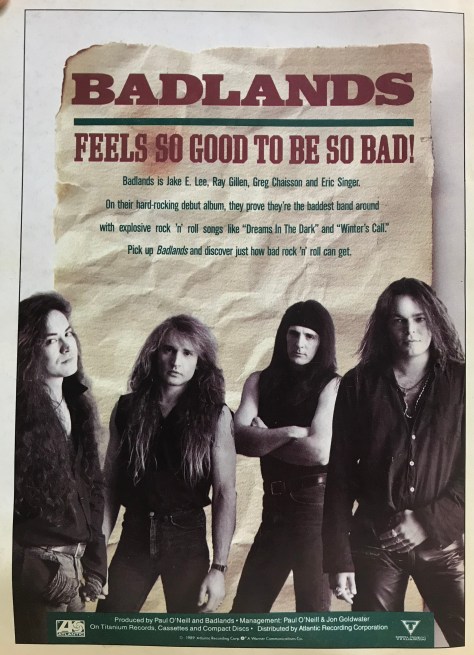
Original advertisement for Badlands self-titled debut, released 30 years ago.

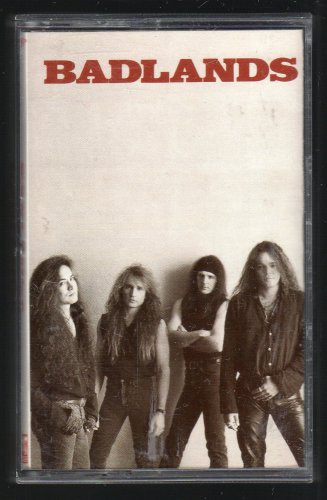
BADLANDS – BADLANDS (1989)

Ahh memories…oh do I have some when it comes to Badlands. Of course, any discussion of Badlands and Jake E. Lee has to start off with his time with Ozzy Osbourne. The Ultimate Sin album was the first Ozzy album I bought and it remains my personal favorite. Since Lee was the guitarist on that album, I obviously have a soft spot for him.

So when I first saw/heard the video on MTV (most likely on Headbanger’s Ball specifically) for the track “Dreams In The Dark”, I was quickly captivated. But instead of the high flying metal guitar of Ozzy, this was a far more gritty and bluesy guitar driven rock and roll record.

Of course, I was immediately in need of owning the album. Once I had it in my hands, I played it quite frequently. I have to say that I found it amazing from start to finish. I know that might be a bit of spoiler for the rest of the article but this was a case of a band starting out at the peak of their musical abilities.

Impressive as Lee was, it was the voice of Ray Gillen that really cinched my fandom. His relatively brief time with Black Sabbath couldn’t have really foretold the performance he would turn in on this album.

As I said, I loved the album. Each song is just full of blazing rock and roll. Side One (or the East Side as it is billed on the album itself) blazes right from the get-go with “High Wire”. You can hear each individual member’s performance blend into a singular whole. Drummer Eric Singer and bassist Greg Chaisson are just as key here as Lee and Gillen.

“Dancing on the Edge” and “Streets Cry Freedom” are also top notch rockers. Of course, there was a slightly softer side of the band which was displayed with the Lee instrumental “Jade’s Song” and the intriguingly intense and atmospheric “Winter’s Call”. Neither really rises to the accepted norm of what a ballad was in the 80’s but damn if I didn’t love both of the songs.

The album’s West Side continued the band’s intense and hook laden blues rock with the opening track “Hard Driver”, a song whose title sums up the viciously rocking nature of the track. The song “Rumblin’ Train” sounds like a swampy blues drawl that you’d hear in a kind of backwater bar if it wasn’t for the far more powerful sound behind it. “Devil’s Stomp” might start out a little slow but soon earns its name as it rocks and stomps it way through your ears. “Seasons” becomes the “ballad” of the 2nd side of the album but still, I found nothing wrong with this song at all. The closing “Ball & Chain” brings down the house with another fiery guitar driven rocker.

I got to see the band twice in concert. The first show was a headlining club date at the Living Room in Providence, RI. The show was packed (the club routinely oversold their capacity) and by the time Badlands hit the stage, I had moved off the main floor and watched most of the show through the side of the stage area. The opening act was D.A.D. and I spent part of the Badlands set standing next to their drummer. I took some photos at that show but this was long before digital cameras and when I got my pictures back, most of them had been destroyed by the developer. However, the one shot that I didn’t throw away was this amazing shot of Ray Gillen in mid-performance. It actually was a mistaken photo that came out better than anything I could’ve shot on purpose. The band’s performance during the show was great even if I didn’t get to see it straight on.

The second show saw them as the opening band for Tesla and Great White at Great Woods in Mansfield, MA. That show was solid but it was obviously far shorter given their status as the opener.

While the band’s commercial fortunes didn’t match the quality of their material, I have no qualms saying that the Badlands album is without a doubt one of the best debut albums released during “The Metal Years”. It’s an album that found the band with all their combined experience already at the top of their game. If they’d been able to fend off all the problems that came their way (feuds, splits, death and withdrawal from the spotlight), I think they would’ve ended up as a far more important band than most would see them as these days. I think they really had that kind of potential. Don’t believe me? Check out this album and I believe you’ll change your mind.

NOTES OF INTEREST: After years out of the music spotlight, Jake E. Lee is back with his band Red Dragon Cartel. They’ve released two albums thus far. Eric Singer left Badlands after this first album. He was replaced by ex-Racer X drummer Jeff Martin. Singer went on to join Kiss where’s he’s been for years. Greg Chaisson had a solo album released in 1994 and made appearances on a few albums since the split but there’s no credits to his name that I can find since 1998. Ray Gillen died from AIDS-related complications in 1993.

In 1998, third album from the band was released in Japan. It is called Dusk. I have it and it is actually quite a good album.

The album was produced by Paul O’Neill, who among his many credits, was responsible for Trans-Siberian Orchestra (and a number of albums from Savatage before TSO came into being). The keyboard programming on Badlands was done by Bob Kinkel who was also a driving force in TSO.

And on a personal note, if anyone knows where I can get an inexpensive CD copy of this album it would be most appreciated as my cassette is pretty close to giving up the ghost.

The Cassette Chronicles – BEGGARS & THIEVES self-titled debut

By JAY ROBERTS

The Cassette Chronicles is a continuing series of mini reviews and reflections on albums from the 1980’s and 1990’s. The aim of this series is to highlight both known and underappreciated albums from rock, pop and metal genres from this time period through the cassette editions of their releases. Some of the albums I have known about and loved for years, while others are new to me and were music I’ve always wanted to hear. There will be some review analysis and my own personal stories about my connection with various albums. These opinions are strictly my own and do not reflect the views of anyone else at Limelight Magazine.

BEGGARS & THIEVES – BEGGARS & THIEVES (1990)

Ahhh memories…I wish I could say that I had some when it comes to writing about Beggars & Thieves. Though I remember the band getting a promotional push when this first album of theirs was released, I’d be lying if I said that I remember much about them beyond that the lineup featured bassist Phil Soussan. I didn’t buy the album and can’t truthfully recall ever having heard any of the songs on the radio.

Of course, that’s part of the fun of this series. I get to look back at things I missed way back when and listen with mostly new ears. Sometimes that doesn’t quite pay off because the music isn’t great. Other times, it becomes a revelation because the music is so great that you find yourself becoming a belated fan. And then there are times when it is a mix of both of those trains of thought.

Such is the case with the band’s self-titled debut album. The album kicks off with a somewhat overlong intro to the song “No More Broken Dreams”. The intro went on long enough that I started wondering if the song was supposed to just be an instrumental. After that buildup the song started off in earnest. At first I wasn’t all that charmed by the track. However, the longer the song went on, it strangely grew on me. I think the vocals by singer Louie Merlino are what really captured my imagination.

Now I can’t say that I was that big of a fan of the rest of the songs on side one. Leaving aside my relative disdain for the ballad “Your Love Is In Vain”, the remaining three songs are all fast paced rockers. But the songs (“Billy Knows Better”, “Waitin’ For The Man” and “Isn’t It Easy”) all just failed to rise above much more than a description of “OK” for me. They aren’t bad songs, just kind of run of the mill with nothing you haven’t heard a million times before to set them apart.

After that somewhat disappointing first side, I wondered if there would be a change on the album’s second side. I wasn’t crazy about the side two opener “Let’s Get Lost”, but after that, the band rose to the occasion when it came to putting together some really great rocking numbers.

As a whole, the songs “Heaven & Hell” (not a Black Sabbath cover) and “Love Junkie” are just flat out fantastic tracks. But what really drove them home for me was the guitar work. Ronnie Mancuso was the guitarist for the band (with Merlino and Soussan credited with providing “additional guitar”) and he shined on these tracks in particular.

The oddly titled ballad “Kill Me” was just awful but the album closed out strongly with a the outstanding “Love’s A Bitch” and the title track. The band did a video for that title cut and the song was definitely worthy of being spotlighted for said video treatment

For a band that barely made an impression on me when they first launched, I was surprised to learn that they’d released four albums and an EP. The last album was released in 2011 and titled We Are The Brokenhearted. It reportedly got great reviews worldwide.

While I wasn’t overly sold on the debut album’s first side, the markedly improved songs on Side Two helped make this album an album that I’m happy to have finally discovered. More to the point, it actually created a desire to hear more of the band’s material to see just what I might’ve missed out on. I can’t think of a better endorsement than that.

NOTES OF INTEREST: Bassist Phil Soussan and drummer Bobby Borg left the band after this first album. Soussan left to join Vince Neil’s solo band. Borg would later play drums for Warrant on their Belly To Belly and Warrant Live 86 – 97 albums.

Though the band continued after the lineup changes (which included the addition of Billy Squier drummer Bobby Chouinard on drums) their second album, Look What You Create, didn’t come out until 1997. The album was recorded in 1992 but Epic Records dropped the band without releasing the album as the grunge music scene exploded.

Though he wasn’t a member of the band, Alan St. John played keys on the album. Like Bobby Chouinard, he played on a number of albums from Billy Squier, among his other credits.


The Cassette Chronicles #100 – Savatage’s ‘Gutter Ballet’

By JAY ROBERTS

The Cassette Chronicles is a continuing series of mini reviews and reflections on albums from the 1980’s and 1990’s. The aim of this series is to highlight both known and underappreciated albums from rock, pop and metal genres from this time period through the cassette editions of their releases. Some of the albums I have known about and loved for years, while others are new to me and were music I’ve always wanted to hear. There will be some review analysis and my own personal stories about my connection with various albums. These opinions are strictly my own and do not reflect the views of anyone else at Limelight Magazine.

SAVATAGE – GUTTER BALLET (1989)

Author’s Note: This is the 100th article in The Cassette Chronicles series. It’s hard to believe what started as a lark on a message board that I remain part of to this day has now seen one hundred individual articles spotlighting some of the best (and worst) of the music of the 1980’s and 1990’s. I just want to say thanks to everyone at Limelight Magazine for giving this series a home these last three years or so. I’d also like to thank everyone that has taken the time to read the articles and send along feedback. This would include those spotlighted bands who have gone out of their way to share the articles on their own social media pages. I hope to bring you another hundred articles over the next few years!

As for this week’s album, I had a choice to make between three albums that I’ve wanted to spotlight for a while now. While the other two will eventually make their way to publication, I figured this anniversary of sorts should spotlight the band that over the course of a few years back in the late 80’s and early 90’s worked their way to becoming my favorite band. It is a title, that despite them not being an active band for years, they retain to this day.

I’m pretty sure that before I heard “When The Crowds Are Gone” on The Metal Zone on 94 HJY (out of Providence, RI), I’d never heard of Savatage before. But hearing that song found me instantly captivated by the way the song built itself into something that started out with a strong but spare piano soundtrack all the way up to an epic sounding number that lent itself to something far more cinematically intense than I could’ve ever expected to hear from a band I was completely unfamiliar with.

In fact, “cinematic” is a recurring theme for pretty much every song on Gutter Ballet. Before delving more into the album, I should note that even though Gutter Ballet was the first album I bought from the band, I went about grabbing up everything they’d produced to that point and was continually swept up into their music. I could say the same for everything that came after Gutter Ballet as well.

The album opens with a thumping riff in the intro to “Of Rage and War”. Singer Jon Oliva’s vocal performance on this song definitely fit the “rage” portion of the song’s title. At times, there was an almost beastial growling undertone to his vocals as he worked his way through the song that was filled with real world concerns about terrorism and other such topics.

While the band would go on to do four concept albums in the years after this album, Gutter Ballet isn’t a true concept album. However, there were some thematic similarities running throughout the album.

With the title track, Savatage launched into a what can only be described as a mini musical suite. It feels like something you’d find on a stage accustomed to hosting plays rather than concerts. The piano opening of the “Gutter Ballet” track gives way to a merging of both the strongly metallic and the strongly melodic. The video for the song and the entire vibe the track engenders that stage play feel I mentioned at the start of this paragraph. I should note that the cover art is a fantastic representation of everything going on with the album’s music.

The instrumental “Temptation Revelation” stands on its own while simultaneously serving as a table setter for “When The Crowds Are Gone.” As someone who writes, it is no surprise that I like words. So lyrics and the person performing them have always come first for me. The fact that I don’t play an instrument probably factors into my personal focus on singers and lyrics. However, it is songs like this that made me focus on the musical aspect a lot more than I usually would. Particularly on the performance of Criss Oliva. I became so enamored of his playing over the years that I ended up considering him my own personal favorite guitarist. There was just something so spectacular about his playing that it made him the first guitarist that I truly loved to listen to just for his own individual playing.

“When The Crowds Are Gone” starts off much like “Gutter Ballet”, with a softer piano-based intro that carries on through the first verse. But then a more explosive rocking soundtrack takes over. The lyrical themes the song builds upon in the song still resonates strongly with me to this day.

The first side of the album closes with another full-length instrumental called “Silk and Steel”. It showcases a lighter touch and I daresay that the song could be called beautiful without sacrificing any of the band’s heavy metal street cred. I should point out that while Jon and Criss Oliva are the focal point of many of the band’s credits, bassist Johnny Lee Middleton and Steve “Dr. Killdrums” Wacholz were just as important to the band’s sound and live performances.

Much like how “Of Rage and War” stands on its own to open the album, “She’s In Love” opens up side two of the album in a similarly singular fashion. The lyrics are pretty easy to figure out and might seem like something that would come from a band that came out of Los Angeles in the early-to-mid 80’s but when couched inside a more frenzied and blitzing soundtrack, the song manages to avoid becoming a cliche.

A more supernatural theme takes over with the songs “Hounds” and “The Unholy”. Both songs are ripping rockers. Though the title implies a plurality of beasts on the loose, I’ve always thought the song was kind of musical homage to the Sherlock Holmes thriller “The Hound of the Baskervilles”. The song does a great job of giving listeners a creepy kind of feeling, even going so far as mentioning the sun setting on the moor. Jon Oliva’s vocal is especially vicious on this track.

As for “The Unholy”, the fiery music combined with another tale that seems ripped from a horror novel, the song establishes itself quickly and drags you on for a scary kind of ride.

Savatage changes things up on the album’s final three songs which are apparently purposely interconnected. “Mentally Yours”, “Summer’s Rain” and the bonus track “Thorazine Shuffle”. “Mentally Yours” starts off with a piano before giving way to a heavier sound. It’s the opening salvo in the “story”. “Summer’s Rain” serves as the middle point of everything and then “Thorazine Shuffle” brings things to a crushing and haunting end.

There’s nothing bad to say about this album. However, much like everything Savatage did over the course of their career, it seemed to get little if any traction with the mainstream metal crowd. I’ve carried my passion for the band for years and will talk them up to anyone who asks (and more than a few times to people who didn’t). I was lucky enough to see the band three times in concert and I got to meet at least a few of the band members each time. They have been a huge part of my life in metal music fandom. I’ve made friends based solely on the fact they saw me wearing a Savatage T-shirt at a Def Leppard concert. And I’ve followed many of the new projects the various band members moved onto after Savatage packed it in as a going concern. My photo with the late Criss Oliva from the Gutter Ballet tour date in 1990 at the Living Room in Providence remains a prized possession.

It’s a crying shame in my eyes that Savatage never broke through to big time success until they morphed into Trans-Siberian Orchestra. I’m glad they saw that success of course, but still wish they’d gotten more recognition for what they brought to the metal world.

Still, Gutter Ballet served not only as my starting point with the band but also as an evolution point for the band’s overall sound. They moved from a more traditional heavy metal sound to more of a progressive metal viewpoint. It, like the rest of their albums, deserves a far bigger audience than it got back in the day and I will continue to tout the greatness of Savatage until my dying breath!

NOTES OF INTEREST: The album has been reissued on CD three times. The first was in 1997, then in 2002 and then in 2011. Each reissue featured bonus tracks. I have the 2011 edition on CD which comes with an essay from Jon Oliva.

Guitarist Chris Caffery is credited on the album as having played guitar and keyboards on the album. However, he didn’t actually play on Gutter Ballet, though he was hired to join the permanent lineup for the tour.

The album was originally slated to be named after the song “Temptation Revelation” and then it was changed to Hounds of Zaroff before the band wrote the “Gutter Ballet” song and settled on that as the album’s title. The song itself featured Jon Oliva not only on vocals but he played the drum and bass tracks as well.

Jon Oliva had a stroke in 2016. It’s reported that he recovered fully from it but recent reports say that he has retired from live performance and I’ve heard nothing about any new music being recorded. His 2013 solo album Raise The Curtain is utterly brilliant.


The Cassette Chronicles – Keel’s ‘Keel’

By JAY ROBERTS

The Cassette Chronicles is a continuing series of mini reviews and reflections on albums from the 1980’s and 1990’s. The aim of this series is to highlight both known and underappreciated albums from rock, pop and metal genres from this time period through the cassette editions of their releases. Some of the albums I have known about and loved for years, while others are new to me and were music I’ve always wanted to hear. There will be some review analysis and my own personal stories about my connection with various albums. These opinions are strictly my own and do not reflect the views of anyone else at Limelight Magazine.

KEEL – KEEL (1987)

For those of us who consider ourselves passionate fans of music, the truth of the matter is that there is always going to be entirely too much material for us to get to it all in a timely manner. And that’s allowing for the notion that we’ll ever get to it all.

Of course, taking three decades to check out an album is likely pushing the boundaries of the phrase “Better Late Than Never” but such is the case with Keel’s self-titled fourth album. While I have a Facebook friend who is seemingly friends with singer Ron Keel, I can’t begin to even guess whether or not I’ve ever heard a song from the band before now.

Like many metalheads, I’ve of course heard of the band but Keel fell into the category of a band I just never found time for back during metal’s 1980’s golden period. After listening to the Keel album, it would seem they now fall into the category of how did I miss out on them the first time around.

I say that because I was surprisingly taken with this album. Things kick off with a rousing and rocking anthem in “United Nations”. The music is incredibly strong with the guitar work of Bryan Jay and Marc Ferrari being immediately captivating. Ron Keel’s voice quite obviously fit the material but I found myself really listening to his vocals throughout the album, which led me to kicking myself over having ignored the band all these years.

The song “Somebody’s Waiting” was a bit of dip in the quality for me. It’s okay but doesn’t seem to have quite the same energetic feel as most of the other tracks on the album. Seeing how the album was put out in 1987, you can imagine that there was a power ballad type of song included. And with “Calm Before The Storm”, you’d be right in that assumption. I wasn’t quite taken with the song but I did like that the lyrics didn’t suffer from a sugary overload of trite emotional waterworks.

Still, the first side of the album is explosively rocking with the killer “Cherry Lane” and “King of the Rock”. The latter song is a furious blaze of music, with the song’s opening guitar driven intro quickly establishing itself as a song that needs to be not only heard, but played repeatedly…on 11!

The second side of the album opened up a little weaker than I would’ve hoped. “It’s a Jungle Out There” isn’t necessarily a bad song. The fast paced number just kind of felt rushed and everything ran together for me. It didn’t feel as if it truly blended all the elements together.

However, that’s the only down note about the second side of the album. Because wow did Keel kill it with the other songs. I don’t know what it was about the title “I Said The Wrong Thing To The Right Girl” but from the title to the actual song there was just something about the song that really appealed to me. I know that the title may seem a little silly but for me, any residual giggles about the title were blown away by just how good the song was. Another potentially silly sounding title was “If Love Is A Crime (I Wanna Be Convicted)”. I know it sounds kind of like something that would be included on a Ramones album but again the song itself is so strong that the title is just left in the dust when you think of it.

I thought “Don’t Say You Love Me” was a standout track. And thankfully, the song was a balls out rocker. Keel ends the album with literal and figurative fireworks. The song “4th of July” explodes from start to finish. Given that we just had the holiday recently, the way the song concludes with the inclusion of recorded fireworks going off, it was a nice kind of celebratory way to end the album.

So I’ve once again been surprised by my own musical ignorance. As I listened to each song I kept wondering why this album hadn’t been a bigger thing back in the day. The irony of thinking that while I was one of those millions who ignored the band and album does not escape me.

I will say that while the cassette played well enough for me to be able to write this article, it does seem like it might be ready to give up the ghost. I don’t say this often but I liked the album so much that I’m going to be looking to upgrade to a CD edition as soon as I can because the Keel album is just too good for me to not have in my musical collection anymore.

NOTES OF INTEREST: Guitarists Marc Ferrari and Bryan Jay would leave the band a year after the release of this album. However, they rejoined the band in 1998 and again in 2009 for Keel’s 25th anniversary reunion.

Black ‘N Blue frontman Jaime St. James sang backup vocals on “It’s A Jungle Out There” and “If Love Is A Crime (I Wanna Be Convicted)”

The song “Calm Before The Storm” was co-written by the longtime Dio and Rainbow bassist Jimmy Bain.

The Cassette Chronicles – Def Leppard’s ‘Pyromania’

By JAY ROBERTS

The Cassette Chronicles is a continuing series of mini reviews and reflections on albums from the 1980’s and 1990’s. The aim of this series is to highlight both known and underappreciated albums from rock, pop and metal genres from this time period through the cassette editions of their releases. Some of the albums I have known about and loved for years, while others are new to me and were music I’ve always wanted to hear. There will be some review analysis and my own personal stories about my connection with various albums. These opinions are strictly my own and do not reflect the views of anyone else at Limelight Magazine.

DEF LEPPARD – PYROMANIA (1983)

As I set to writing this article I was trying to come up with some new kind of angle that hasn’t been covered ad nauseum over the 36 years since Def Leppard first released Pyromania. But whether it is talking about the big hit songs from this album that launched the band into the stratosphere of rock royalty or the painstakingingly intense recording of the album as spearheaded by Mutt Lange, there’s not a whole heck of a lot that hasn’t been written about the album.

Yes, Pyromania is the album that truly launched the band’s career. Their two previous albums are really good. There’s no doubt about that. But in comparison to this album and then the even more massive success of Hysteria, both On Through The Night and High ‘n’ Dry somehow come off as relatively overlooked. For all the talk about how intense the collaboration with Lange was for this album, you can’t fault the finished product. There’s ten songs on the album and even though three songs are recognized as all-time rock classics, there is not a single bad track on the album (Okay, to be honest, I hate the outro on the album closing “Billy’s Got A Gun”). To this day, how can you not get a little shot of electricity when you hear “Photograph”, “Rock of Ages” or “Foolin'”?

But I love songs like “Stagefright” and “Die Hard The Hunter” as well. And the opening salvo of “Rock! Rock! (Til You Drop)” still gets me all keyed up to listen to the album in full.

See what I mean? It’s nice to read that stuff, but I’m not exactly saying anything that hasn’t been written before.

So instead, I thought I’d just go into a little bit of my own experience with the album instead. Pyromania was one of the first albums I ended up with as I took my initial foray into what has become a passionate love of rock and metal.

I can’t remember exactly how I came to possess my cassette copy of the album, but I am pretty sure that my parents bought it for me. Which is quite amusing when you consider that they wouldn’t buy me REO Speedwagon’s Hi Infidelity or Twisted Sister’s Stay Hungry albums when I asked for them because of the cover art. But if you take a look at the cover art for Pyromania, you might wonder why that was an okay piece for them to buy me.

Anyway, I still have that very cassette but for some reason I do not have the original case or the liner notes card that came with it. Instead, for years it has been stored in holder that was originally for blank cassettes (which were usually used to tape songs off the radio of course!). The liner card was flipped inside out and the track listing was written in hand in blue ink. And the album still plays wonderfully. I’d have to check because I think I did finally upgrade to a CD version of the album but I still love that cassette.

I’ve seen the band in concert twice, once in 1993 and then again in 2000. My sister was a big fan of Def Leppard at one point and I took her to that 2000 show. Rock fandom didn’t quite stick with her though as she’s more of a country music fan these days.

One of the coolest memories I have that is associated with the days of Pyromania is opening gifts that Christmas. My parents had managed to buy me not only an album cover art T-shirt but they had found a Def Leppard Union Jack painter’s cap. Let me tell you, I was pretty stoked when I opened that particular package.

Over the years, there has been an ebb and flow to my fandom for the band. I hated the Slang, Yeah! and Songs from the Sparkle Lounge releases, but I also loved Euphoria and truly raved about the 2015 Def Leppard album. But when I find the band has really hit on all the high marks that define their career, they are a vastly underrated rock act. Yes, I know that they seem to shy away from even being called a rock band, but that’s what they are and that is why I remain pretty devoted to their music.

Hysteria may be the band’s highest benchmark in terms of commercial success (more than 25 million albums sold). But for me and I’m guessing many others, that success wouldn’t have been possible without the breakthrough the band experienced as they worked on what would become Pyromania. It is an album that never fails to entertain me and stands up strong against whatever you might want to throw at it.

NOTES OF INTEREST: English musician Thomas Dolby, best known for the hit pop song “She Blinded Me With Science” played keyboards on the Pyromania album. He’s credited under the pseudonym Booker T. Boffin.

Producer Mutt Lange provided backing vocals on the album and did the spoken word intro on the song “Rock Of Ages”.

Despite being fired from the band before the completion of recording Pyromania, guitarist Pete Willis played the rhythm guitar tracks for all ten songs on the album.

The Cassette Chronicles – Beau Nasty’s ‘Dirty, But Well Dressed’

The Cassette Chronicles is a continuing series of mini reviews and reflections on albums from the 1980’s and 1990’s. The aim of this series is to highlight both known and underappreciated albums from rock, pop and metal genres from this time period through the cassette editions of their releases. Some of the albums I have known about and loved for years, while others are new to me and were music I’ve always wanted to hear. There will be some review analysis and my own personal stories about my connection with various albums. These opinions are strictly my own and do not reflect the views of anyone else at Limelight Magazine.

BEAU NASTY – DIRTY, BUT WELL DRESSED (1989)

Even those who consider themselves hardcore fans of the 80’s metal years are likely to have some band that either they have never heard of before. Perhaps there’s a chance they’ve heard the name but memories of the music have been obscured by the passage of time.

The latter might just be the most fitting explanation for the band Beau Nasty. I’m sure most people reading this article are probably scratching their head saying, “Who?”.

Don’t worry though, you are in good company. I am pretty sure that I’ve heard the band’s name before but I can’t really guarantee that. And as for any memories of hearing the music off this sole album they released, nope!

The band is pretty darn obscure to say the least. I looked them up on line and there wasn’t really much to find. There’s not even a Wikipedia page for them.

Of course, after listening to Dirty, But Well Dressed, I can’t say that I’m all that surprised by the lack of information available. The album was released at the pinnacle of metal’s golden years. And despite the band seeming to check every box on the list of what a metal album should have in 1989, the material just really didn’t catch on with seemingly anyone. Of course, the silly album cover with the band posed in Renaissance-era costumes probably didn’t help matters with those people who scoured the shelves for new material to check out.

With the passage of time and new ears to listen though, I was surprised to find that there were some interesting songs to be heard after all. When I first listened to the album, my initial impression of singer Mark Anthony Fretz was that vocally he kind of sounded like a version of Dean Davidson from Britny Fox. Whether it was intentional or just how he sang anyway, the scratchy or raspy vocals gave a bluesy dimension to his performance at times.

The first side of the album kicks off with a song called “Shake It”. It’s not the most original title but there’s a fast paced gritty feel to the song that made me like it in spite of myself. You can check out the video the band made for the song on Youtube. Of course that strong start then gave way to a couple of mediocre rockers in “Goodbye Rosie” and “Gimme Lovin’. Not album killer tracks, but definitely felt like album filler to me.

Of course, those look like pure gold compared to the dreck that was the power ballad “Paradise In The Sand”, a song so dreadfully inane that if the TV show How I Met Your Mother had tried to use it for one of their “Robin Sparkles” episodes, the network’s standards and practices offices would’ve demanded they cut it from the show so they didn’t get arrested for crimes against humanity. Okay, perhaps that’s a bit of an oversell on my part but the song was awful.

Mercifully, the album’s title track close out Side One with a smoking energetic rocker that had me saying out loud as I listened, “I am really liking this one”. While that’s not going to win me any fine writing awards, it isn’t often that I talk to myself out loud while listening to an album for this series, so I look at that as a positive achievement on the band’s part.

Side two dug deep into that bluesy feel with the opening “Love To The Bone”. The song has a slow drawl to the opening sequence before a more driving rock tempo takes over and you are confronted with just a very cool song.

The song “Gemini” had kind of a ballad feel to it but there was more of a musical urgency to the song’s delivery. It gave the song some mildly interesting moments. Based solely on the title of the song, I thought “Piece of the Action” sounded like something that could’ve been on an early L.A. Guns release. However, the pain I felt and that you may feel if you choose to check out the album, returns in full force when another enforced ballad bleats through the speakers on “Make A Wish”. The best thing I can say about it is that it wasn’t worse than “Paradise In The Sand” (Spoiler alert: It was about equal in terms of the overly sappy quotient for this song).

The album closes with a cover of “Love Potion #9”. It is vastly “rocked” up in comparison the original song but it doesn’t do much to make this version any better.

It’s been a while since I’ve written a more downwardly slanted article about one of my albums. While Dirty, But Well Dressed has a few tracks that made things bearable, I can’t really come close to truly recommending that this one go on anyone’s must-listen to list.

NOTES OF INTEREST: As noted, this album was the only one the band produced. They formed in 1988 but had split by 1990.

While Beau Hill served as the album’s executive producer, I was more interested to find that Paul Winger is listed as a producer. Paul is the brother of Kip Winger. Both Beau Hill and Paul Winger, along with brother Nate Winger also helped provide backing vocals on the album as well.

Drummer Mike Terrana would go on from Beau Nasty to play in such heavier acts like Rage, Gamma Ray and Masterplan amongst his many credits.